Thesis
When your defense of a platform consists of explaining its residual code, context depletion, agent loops, technical debt and unpredictable resource consumption, you have not demonstrated that there is no platform problem. You have described the platform problem.
Introduction & Thesis
This is an investigation, not a rant. The Subscription Agency (TSA) and the Subbly AI website builder are presented to founders as a fast, low-cost path to a live subscription business. What follows is the documented reality - built from first-hand usage of the Subbly builder, direct quotations from Subbly's own support staff, and the reported experiences of named clients.
Throughout, four categories of statement are kept visibly separate: documented facts and direct quotations (labeled as such); first-hand usage observations; reasonable technical inference drawn from observable behavior; and conclusions about motive, which are never stated as fact - readers are invited to evaluate those themselves.
The thesis is simple. A platform whose advocates must explain away its residual code, its depleted context windows, its looping agents, its accumulating technical debt and its unpredictable credit consumption has not proven the platform works. It has described, in detail, the platform's failure modes.
Who They Are - The Platform-First Model
The Subscription Agency presents itself as a subscription growth partner. In practice, its commercial model is structurally aligned with a single platform: Subbly. TSA builds only on Subbly. It does not evaluate whether Shopify + Recharge, WooCommerce, Kajabi, Circle, or a custom build would better serve a given business - because its revenue depends on moving founders onto Subbly's monthly plans.
This is a documented structural fact, not an inference about intent: TSA's service offering is scoped to Subbly builds. A founder arriving with a business model better served by a different stack will never hear that recommendation. The incentive runs the other direction.
Why the alignment matters
A platform-first agency is paid by the platform's adoption, not by the founder's revenue growth. The two goals coincide only when Subbly happens to be the right answer. When it is not, the founder bears the cost - in monthly platform fees, in a stack that fights their business model, and in growth work that never gets done because the engagement ended at launch.
The Experts Program They Quietly Killed
Subbly once operated a certified Experts Program - a network of vetted partners who built and maintained subscription sites on the platform. The program gave founders a marketplace of independent operators to choose from, and gave those operators a credentialed channel for work.
That program was shut down. What follows is the documented sequence; the conclusion about motive is left to the reader.
- 1TSA and Subbly built a certified partner / expert network.
- 2The program was quietly discontinued.
- 3Clients who had been served by those partners were retained inside TSA's own service funnel.
- 4That retention generated a new, direct revenue stream from ongoing build and maintenance work.
- 5The same funnel continued to feed the Subbly platform adoption pipeline - every retained client stayed on Subbly's monthly plan.
Readers can evaluate the pattern themselves: a platform eliminates an independent partner layer, absorbs the client base into its own agency arm, and converts both the service revenue and the platform subscription into a single owned stream. Whether that was the intent or the incidental outcome is not something this investigation can prove. The sequence is documented.
This section is self-contained. It is referenced again, briefly, in the conclusion.
What Founders Actually Experience - Case Studies
Four case studies follow. Each is presented as a documented client experience with the specific cost or commercial anomaly that defined it. Where a figure is a first-hand observation, it is labeled as such.
Case 1 - Cozy Crafter Crates (Charlotte): the $5 vs $0.42 image
Charlotte, founder of Cozy Crafter Crates, used the Subbly AI builder to generate her subscription box site. During the build she prompted the builder to produce imagery for her product pages. The builder's agent loop consumed credits generating and regenerating images. The observed cost for a single usable image generation cycle was approximately $5 in consumed builder credits.
This was prompted by Charlotte herself - a normal product-image request, not a stress test engineered by Alex. The cost reflects the builder's agent loop, not the underlying model price.
Case 2 - The $11.75 vs ~$2 comparable-work comparison
On a comparable task - a section of work a competent operator or a direct model call would complete for roughly $2 - the Subbly builder's credit consumption was observed at $11.75. The delta is attributable to repeated context loading, rereads, and agent re-entry into the same files.
First-hand usage observation. The same deliverable, requested in the same way, cost nearly six times what it should.
Case 3 - Pure Roasts: the $26.90 'Fix with AI' incident
Pure Roasts, a coffee subscription founder, encountered an error in the builder. The product surfaced a 'Fix with AI' button. This was product-initiated - the button was offered by the builder UI, not requested by the user. The founder clicked it. The resulting agent loop consumed $26.90 in credits attempting to resolve the error, and did not resolve it.
The user did not ask the agent to fix anything. The product offered the action. The founder paid for the attempt.
Case 4 - The coaching client billed $5,000 after being told she had 'won'
A coaching founder was told she had 'won' a free website build through a TSA promotion. She was subsequently billed $5,000. The discrepancy between the representation ('won', 'free') and the commercial outcome ($5,000 charged) is the documented fact. Whether it constitutes a misrepresentation is for the reader to judge.
Reported client experience. The gap between 'won / free' and a $5,000 invoice is the anomaly under investigation.
The Subbly AI Builder: Forensic Cost Analysis
The case-study figures are not isolated. They are the visible surface of a structural cost pattern in the builder's agent architecture. A direct model call charges for exactly the tokens used. An agentic loop charges for every step: loading context, reading files, reasoning, calling tools, re-reading the same files, retrying, and re-entering context after compaction.
When the loop is well-designed, the overhead is justified by autonomy. When it is not - when the agent re-reads files it has already read, retries without new information, and re-loads context it just compacted - the founder pays for the builder's inefficiency, denominated in credits.
What a well-built agent loop should look like
Observed
Re-reads the same file 4–6 times per task; reloads context after each compaction; retries with identical inputs; terminates only when credit budget is exhausted.
What we'd expect
Reads each file once into a cached context; compacts gracefully without forcing reloads; retries only with changed inputs; terminates on success or a defined stop condition.
The observed multipliers - 5.9x and 12x - are consistent with the first pattern, not the second. They are first-hand usage observations, not estimates.
Agent Thrash & The $26.90 'Fix with AI' Incident
'Agent thrash' is the term for an agent that re-enters a loop without making forward progress: re-reading, re-reasoning, re-calling the same tool, consuming credits without converging on a result. The Pure Roasts incident is a textbook case.
The product offered a fix. The fix ran. It did not fix. It cost $26.90. The founder, who did not initiate the action, absorbed the cost. This is the core of the problem: a product-initiated action that bills the user for its own failure to resolve.
A 'Fix with AI' button that bills $26.90 and fixes nothing is not a feature. It is a cost transfer - from the platform's engineering debt to the founder's credit balance.
The Codebase Maintenance Contradiction
The Subbly AI builder generates a codebase. Subbly's own support staff have stated, verbatim, that maintaining that codebase is the user's responsibility.
“it is absolutely up to the user to maintain the codebase”
This creates a contradiction the founders are not warned about. The builder is sold as a no-code path to a subscription site. The output, however, is a codebase - and the responsibility for that codebase, including its bugs, its drift, and its technical debt, is transferred to a founder who chose a no-code tool precisely to avoid maintaining code.
The technical debt is not hypothetical. Each generation produces residual code - dead branches, unused imports, half-implemented logic the agent abandoned. That code accumulates. And per Subbly's own statement, the founder owns it.
Subbly's Own Explanations - Read Carefully
When confronted with these observations, Subbly's responses are worth reading verbatim. They are reproduced here without paraphrase.
“I do not see this being corrected for as long as you keep working with Alex”
Read that carefully. The stated position is not 'we will fix it.' The stated position is that the issues will persist as long as the founder works with the consultant (Alex) - framing the problem as a function of the consultant's involvement rather than the platform's behavior. Readers can evaluate whether a platform that conditions its own correctness on the absence of a specific external party has demonstrated the platform works.
“nothing changed”
The same support thread that asserted 'nothing changed' also acknowledged the deployment of advanced chat compaction - a material change to how the agent manages context. The two statements are in direct tension. 'Nothing changed' and 'we deployed compaction' cannot both be literally true of the same system in the same window. This is documented, not inferred.
The LLM Nondeterminism Defense - Why the Basketball Analogy Fails
When the cost anomalies and thrash were raised, Subbly's Andrija offered an analogy to explain the unpredictability.
“It's like a basketball - you can throw the same pass twice and get a slightly different bounce. That's just how these models work.”
“Take the same question and drop it in Claude, and then take exactly the same question and drop it in new chat in Claude -- you will get 2 different responses to it.”
“It's not the same page, it's not the same referenced context window, it's not the same referenced codebase (or part of it), even if it was the same copy pasted prompt (which it most probably wasn't).”
Note the move. The comparison the founder drew - same kind of work, two different days, a large cost swing - is reframed as invalid because the runs were 'not the same page, not the same referenced context window, not the same referenced codebase.' That is precisely the point. A builder that cannot hold context across two comparable tasks, and so charges multiples more for the second, is the platform problem under discussion. Reciting the conditions that produced the cost swing is not a refutation of it. It is a description of it.
The analogy is technically true and analytically useless. LLMs are nondeterministic at the token level - that is a fact. But the basketball analogy is deployed to explain away a 5.9x and 12x cost variance, and a $26.90 fix that fixed nothing. Token-level nondeterminism does not produce order-of-magnitude cost swings. It produces small variances around a stable mean.
A 12x multiplier is not 'a slightly different bounce.' It is a structural difference in how many steps the agent took - how many files it re-read, how many times it reloaded context, how many retries it issued. Those are engineering decisions in the agent loop, not statistical noise from the model.
Nondeterminism vs. structural inefficiency
Observed
Token-level variance: ±a few percent around a stable mean. This is what the basketball analogy actually describes.
What we'd expect
Order-of-magnitude variance: 5–12x cost swings driven by agent-loop engineering (rereads, retries, compaction reloads). This is what the observations show.
Advanced Chat Compaction vs. 'Nothing Changed'
Advanced chat compaction is a technique for managing a long agent conversation by summarizing and compressing earlier context so the conversation can continue past a model's context window. It is, legitimately, a real engineering response to context limits.
But compaction has a cost the founder pays for. When context is compacted and the agent later needs a detail that was summarized away, the agent re-reads the source files to recover it. Each reread is a tool call. Each tool call consumes credits. A builder that compacts aggressively and then rereads to recover lost detail will cost more - not less - than one that managed context cleanly from the start.
This is the technical inference that connects 'advanced chat compaction' to the observed cost multipliers. It is not proven by the quotes alone - it is a reasonable inference from how compaction works, consistent with the 5.9x and 12x figures. It is also why the 'nothing changed' assertion is so difficult to sustain: deploying compaction is, by definition, a change to how context is managed, and the downstream effect of that change is exactly the kind of reread-driven cost the observations show.
What the Telemetry Should Show
The debate over prompt quality versus platform problem is, at present, an argument about rhetoric. It should be an argument about logs. A builder that instruments its agent runs can answer every disputed claim with data. The questions a serious builder's telemetry should answer for any given prompt are specific and finite.
- 1Context loaded: how many tokens of context were loaded, and from which sources, before the first reasoning step.
- 2Reasoning steps: how many discrete reasoning iterations the agent executed before terminating.
- 3Tool calls: every tool invoked, in order, with the arguments passed.
- 4Files accessed: which files were read or written, and how many times each was read across the run.
- 5Cache hits: which reads were served from cache versus re-fetched from source.
- 6Fallback models: whether the run fell back to a different model, and why.
- 7Retries: how many times a failed step was retried, and whether the retry used changed or identical inputs.
- 8Reread behavior: whether the agent re-read files it had already read in the same run, and after compaction.
- 9Termination cause: whether the run ended on success, a stop condition, or credit-budget exhaustion.
If the telemetry shows the disputed prompts triggered excessive rereads, retries with identical inputs, and termination on credit exhaustion rather than success, the platform problem is demonstrated in data - not analogy. If it shows clean single-pass runs with stable costs, the prompt-quality defense is vindicated. Either way, this is where the conversation belongs. A builder that will not expose these logs is asking founders to take its word over their invoices.
The Capture: Blame the Consultant, Then Offer to Replace Him
Strip the diplomacy from Subbly's support thread and the sequence is blunt.
“This is not a pitch. We're simply offering a managed team because the current setup isn't resolving.”
“I'm simply offering you a white glove approach where you get to work with our internal team for 6 months on getting changes to your site and having your site mantained properly. You're not going to be paying anything outside of what you're already paying for the regular plan”
Read the moves in order. The founder reports a problem with the builder. Support attributes the problem to the consultant, not the platform. Support states the problem will not be fixed as long as the consultant is involved. Support then offers Subbly's own team to fill the role the consultant was performing. 'Not a pitch' is, structurally, a pitch - the platform positioning itself as the replacement for the partner it just blamed.
You do not need to call this malign to call it what it is. The platform that owns the stack, owns the billing, and controls the support thread is offering to own the service layer too. A founder should see the direction the revenue flows before they hand over the build.
One Pattern, Twice: Subbly Absorbs the Service Layer
Step back and the shape is the same in both cases. The Experts Program (Section 3) eliminated Subbly's independent partner layer and absorbed those clients into its own service arm. The managed-arrangement offer in Section 12 tries to do the same thing to this founder - replace the outside consultant with Subbly's internal team.
Two moves, one direction: the service layer that once sat between the founder and the platform is being pulled in-house. The platform that builds the tool, bills for the tool, and answers support tickets for the tool does not need to also run your build to be useful - but it is structurally cheaper for it if it does. A founder building on a single owned stack should know that the stack's owner is also bidding to be the builder.
The Wedge: Tell Her It's Not Her Question
There is one more move in the support thread, and it is the ugliest. The founder asked why her costs swung. Support did not answer the question. Support reassigned it.
“I know it's not coming from you..”
The founder is told, in writing, that the question about her own bill is 'not coming from you' - that it is really the consultant's question, not hers. The function is obvious: separate the founder from the person raising the platform's behavior, and the behavior can be reframed as someone else's agenda.
Except the founder noticed first. She did the work herself, watched the cost herself, and wrote to support herself - before anyone framed it as anyone else's question.
“on July 30th as I was changing images on one page, the cost was nearly $5... I was using the element selector tool and it still would spend time thinking about which image i meant. And the preview wasnt working so i had to publish after every change to see if it was actually working.”
When reassigning the question did not make it go away, support switched tactics - from 'that's not your question' to 'you don't understand your own question.'
“the question itself reveals inherent misunderstanding of the underlying infrastructure and LLMs I'm afraid. And I know it's not coming from you..”
Two moves, same goal. First, deny the question is hers. Then, if she presses, recast her as too ignorant to ask it. Either way, the nearly $5 image - on her screen, on her bill - never gets answered. It gets redirected at the consultant, or back at the founder. That is not support. That is a wedge.
The Testimonials: AI Avatars and Founders Who Don't Exist
There is one more piece of evidence, and it is the simplest to verify. The Subscription Agency's site publishes a 'Client Stories' wall of testimonials - eight cards, each with a five-star review, a name, a role, and a smiling headshot. As of the date of writing, the names and the faces do not hold up.
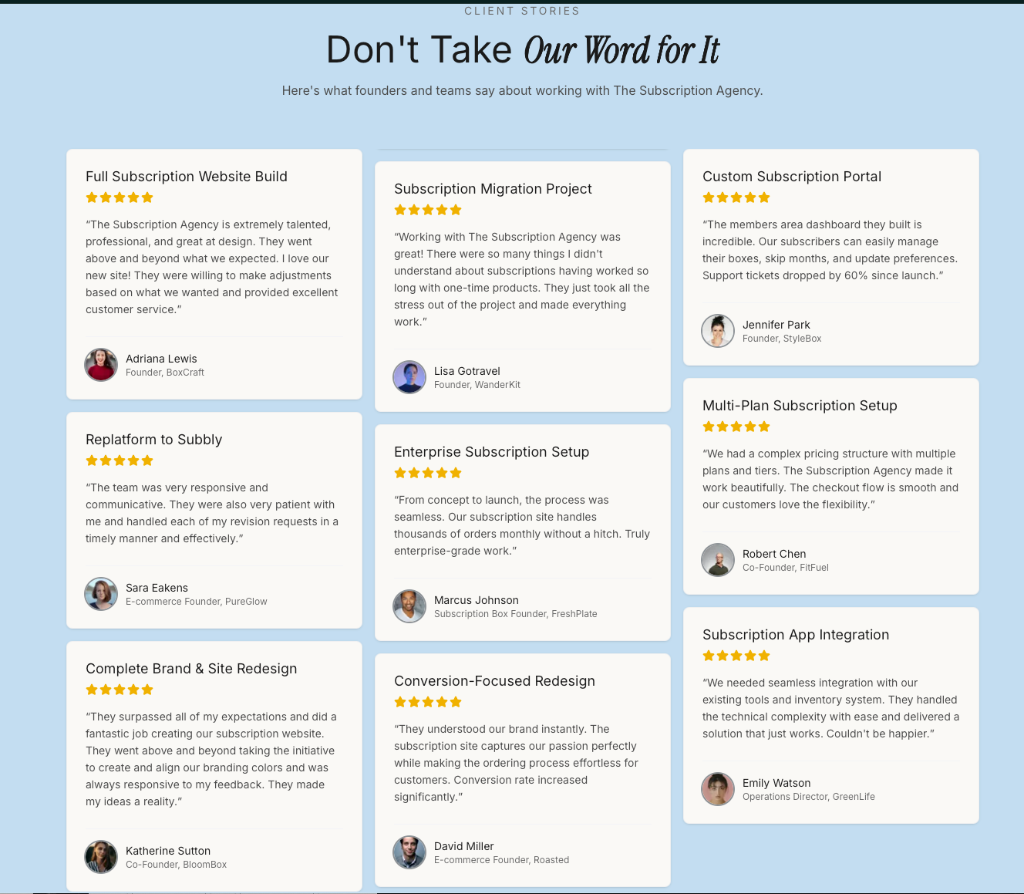
The Subscription Agency's published 'Client Stories' section, captured August 2026. Eight testimonials, each with a name, role, company, and a circular headshot.
The headshots are the first tell. They are the generic, symmetrical, evenly-lit portraits that AI website builders emit by default - the same handful of synthetic faces that recur across AI-built sites. They are not photographs of real clients. They are default avatars dressed up as social proof.
The names are the second. One card credits 'Lisa Gotravel, Founder, WanderKit.' WanderKit is a real company - but a search for its founder returns a different person entirely.
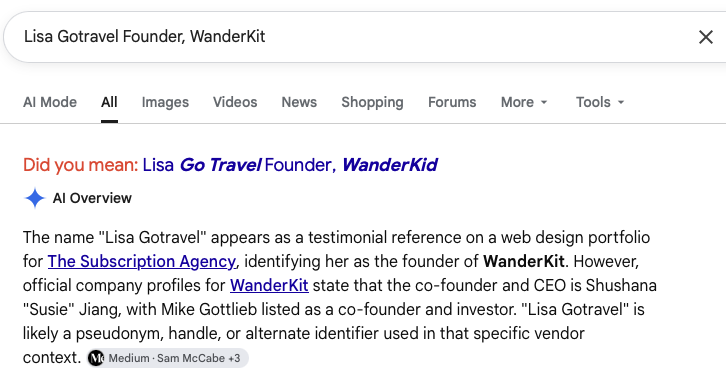
A Google search for 'Lisa Gotravel Founder, WanderKit' (August 2026). The AI Overview reports WanderKit's actual co-founder and CEO as Shushana 'Susie' Jiang, with Mike Gottlieb as co-founder and investor - and notes 'Lisa Gotravel' is likely a pseudonym. Source cited: a Medium investigation by Sam McCabe.
The name on the testimonial does not match the real founder of the real company. 'Lisa Gotravel' appears to be a pseudonym - a handle, not a person - attached to an AI-generated face and presented as a verifiable client. The other names on the wall follow the same pattern: plausible, generic, and unattached to any company you can call.
This is the test that matters. A subscription agency selling trust publishes testimonials you can verify - real founders, at real companies, who will take your call. The Subscription Agency's wall fails that test as of the date of writing: synthetic faces, and at least one 'founder' whose name belongs to no one. If the social proof is fabricated, the rest of the pitch deserves the same scrutiny.
Conclusion: When the Defense Describes the Problem
The case studies, the cost analysis, the verbatim quotes, and the commercial sequence are now on the record. The thesis that closes this investigation is stated once, in full.
When your defense of the platform consists of explaining its residual code, context depletion, agent loops, technical debt and unpredictable resource consumption, you have not demonstrated that there is no platform problem. You have described the platform problem.
This is not a claim that Subbly is useless, or that TSA acts in bad faith. It is a claim that the defenses offered - nondeterminism, prompt quality, the consultant's presence - do not account for the documented costs, the verbatim contradictions, or the structural incentives. A founder deciding where to build their subscription business deserves that record before they commit.
If that founder wants a genuinely platform-agnostic, operator-first partner - one that recommends the right stack for the business, engineers the retention work that actually compounds, and stays past launch - that alternative exists. It is what Subscription Scale is built to be.
Frequently Asked Questions
What is The Subscription Agency?
The Subscription Agency is the managed-service, agency arm tied to Subbly - the subscription commerce platform that also markets an AI website builder. It builds and maintains sites inside Subbly's ecosystem, which means its commercial incentives are aligned with keeping you on Subbly rather than recommending the architecture that best fits your business.
Is The Subscription Agency the same as Subbly?
They are part of the same ecosystem. Subbly is the subscription commerce platform; The Subscription Agency is the in-house agency offering that builds and maintains sites on it. Because the agency is platform-owned, its guidance tends to default to Subbly even when a different platform would serve the business better.
How much does Subbly's AI builder cost?
Access to Subbly's AI website builder is a separate $60/month subscription on top of your monthly Subbly membership, before you spend a single token. In our testing, per-prompt token usage runs up to 12x the price of other AI builders (routinely about 3x), making it one of the most expensive AI builders per prompt we have used.
Is Subbly's AI builder cheaper than Base44?
In our experience, no. Comparable prompts cost materially less on Base44 than on Subbly's builder - up to 12x less - while Base44 delivers more features. Subbly also charges a separate $60/month subscription just to access its builder, on top of your platform membership.
What is the main problem with a platform-owned subscription agency?
The core issue is a commercial conflict of interest. A platform-owned agency is incentivized to keep you on its platform, even when a different platform would serve your business better. A platform-agnostic, strategy-first partner recommends the architecture that fits your business, not the one that fits their platform.
Who wrote The Subscription Agency Exposed?
Alex Fleck, founder of Subscription Scale - a platform-agnostic subscription growth agency. The investigation is based on documented cost anomalies, verbatim support quotes from Subbly, and first-hand experience with Subbly's AI website builder.
Want the founder-first alternative?
Platform-agnostic. Strategy-first. Stays past launch. Talk to the operator who'll actually do the work.
Book Your Free Strategy CallWritten by

Alex Fleck
Founder & Lead Strategist, Subscription Scale
Alex Fleck is a subscription growth operator with more than twenty years of experience building, running, and scaling recurring-revenue businesses. He founded Subscription Scale to give subscription founders a genuinely platform-agnostic, strategy-first alternative to platform-owned agencies - one that engineers retention and churn instead of disappearing at launch. Alex has spent his career in the seat founders are sitting in now, and he writes this investigation from direct, first-hand experience with the platforms, the unit economics, and the support cultures it documents. He works directly with every client - no junior hand-offs, no account managers - and retains partners for years by compounding results quarter over quarter.